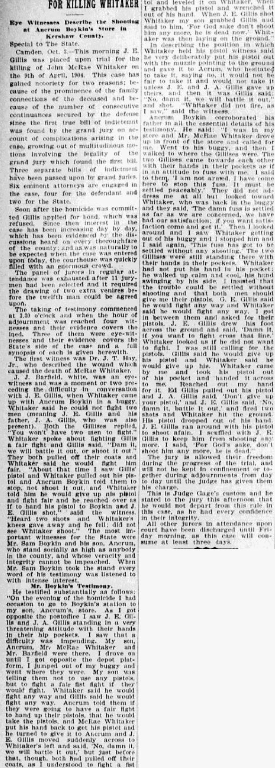
Eye Witnesses Describe the Shooting at Ancrum Boykin’s Store in Kershaw County.
Special to The State.
Camden, Oct. 3.–This morning J. E Gillis was placed upon trial for the killing of John McRae Whitaker on the 9th of April, 1904. This case has gained notoriety for two reasons; because of the prominence of the family connections of the deceased and because of the number of consecutive continuances secured by the defense since the first true bill of indictment was found by the grand jury on account of complications arising in the case, growing out of multitudinous motions involving the legality of the grand jury which found the first bill.
Three separate bills of indictment have been passed upon by grand juries. Six eminent attorneys are engaged in the case, four for the defendant and two for the State.
Soon after the homicide was committed Gillis applied for bond, which was refused. Since then interest in the case has been increasing day by day, which has been evidenced by the discussions heard on every thoroughfare of the county: and as was naturally to be expected when the case was entered upon today, the courthouse was quickly filed with an enormous crowd.
The panel of jurors in regular attendance was exhausted after 11 jurymen had been selected and it required the drawing of two extra venires before the twelfth man could be agreed upon.
The taking of testimony commenced at 3:30 o’clock and when the hour of adjournment was reached four witnesses and their evidence covers the ined. Three of them were eye-witnesses and their evidence covers the State’s side of the case and a full synopsis of each is given herewith.
The first witness was Dr. J. T. Hay, Jr., who described the wound which caused the death of MeRae Whitaker.
J. J. Barfield, white, was an eyewitness and was a moment or two preceding the difficulty in conversation with J. E. Gillis, when Whitaker came up with Ancrum Boykin in a buggy. Whitaker said he could not fight two men (meaning J. E. Gills and his father, J. A. Gillis, who was also present). Both the Gillises repiled
“You won’t have two men to fight.” Whitaker spoke about fighting Gilis a fair fight and Gillis said, “Dam it, we will battle it out, or shoot it out,” They both pulled off their coats and Whitaker said he would fight him fair. “About that time I saw Gillis’ pistol and Whitaker pulled out his pistol and Ancrum Boykin told them to stop, not shoot it out, and Whitaker told him he would give up his pistol and fight fair and he reached over as it to hand his pistol to Boykin and J. E. Gillis shot,” said the witness.
“Heard two shots and Whitaker’s knees gave away and he fell; did not see Whitaker shoot.” The most important witnesses for the State were Mr. Sam Boykin and his son, Ancrum, who stand socially as high as anybody in the county, and whose veracity and integrity cannot be impeached. When Mr. Sam Boykin took the stand every word of his testimony was listened to with intense interest.
Mr. Boykin’s Testimony.
He testified substantially as follows: “On the evening of the homicide I had occasion to go to Boykin’s station to my son, Ancrum’s, store. As I got opposite the post office I saw J. E. Gillis and J. A. Gillis standing in a very threatening attitude with their hands in their hip pockets. I saw that a difficulty was impending. My son, Ancrum, Mr. McRae Whitaker and Mr. Barfeld were there, I drove on until I got opposite the depot platform, I jumped out of my buggy and went where they were. My son was telling them not to use any pistols, but to fight a fair fist fight if they would fight. Whitaker said he would fight any way and Gillis said he would fight any way. Ancrum told them if they were going to have a fair fight to hand up their pistols, that he would take the pistols, and McRae Whitaker put his hand back to get his pistol and he turned to give it to Ancrum and J. E Gillis moved suddenly across to Whitaker’s left and said, ” No, damn it, we will battle it out,” but just before that, though, both had pulled off thei coats, as I understood to fight a fist fight. Just as Whitaker started to turn , the shooting commenced by J. E. Gillis. Two shots were fired and Whitaker fell.
As he fell J. A. Gillis made one step forward, pulled his pistol and leveled it on Whitaker, when I grabbed his pistol and wrenched it out of his hand. When J. E. Gillis shot Whitaker my son grabbed Gillis and said to him, “For God sake don’t shoot him any more, he is dead now? Whitaker was then laying on the ground.”
In describing the position in which Whitaker held his pistol witness said he very deliberately put his pistol out with the muzzle pointing to the ground and gave it to Acrum, who hesitated to take it, saying no. It would not be fair to take it and would not take it unless J. E. and J. A. Gillis gave up theirs, and then it was Gillis said” “No, damn it, we will battle it out,” and shot “Whitaker did not fire, as I saw,” said the witness.
Ancrum Boykin corroborated his father in all the essential details of his testimony. He said “I was in my store and Mr. McRae Whitaker drove up in front of the store and called for me. Went to his buggy, and then I walked to where the Gillises were. The two Gillises came towards each other with their hands in their pockets as if in an attitude to fuss with me. I said to them, “I am not armed, I have come here to stop this fuss. It must be settled peaceably.” They did not address me at all but looked toward Whitaker, who was back in the buggy and they said, “The damn fuss is settled as far as we are concerned, we have had our satisfaction: if you want satisfaction come and get it.” Then I looked around and I saw Whitaker getting out of his buggy and I stopped him and I said again. “This fuss has got to be settled without any shooting. The two Gillises were still standing there with their hands in their pockets. Whitaker had not put his hand in his pocket: he walked up calm and cool, his hand swinging by his side, I insisted that the trouble could be settled without shooting and that both men should give me their pistols. G. E. Gillis said he would fight any way and Whitaker said he would fight any way. I got In between them and asked for their pistols. J. E. Gillis drew his foot across the ground and said, ‘Damn It, If you want to fight cross that line.” Whitaker looked as If he did not want to fight. I was still calling for the pistols. Gills said he would give up his pistol and Whitaker said he would give up his. Whitaker came by me and took his pistol out of his pocket and handed it across to me. Reached out my hand for it. Ed Gillis pulled out his pistol and J. A. Gillis said, “Don’t give up your pistol,” and J. E. Gillis said, “No, damn it, battle it out,” and fired two shots and Whitaker hit the ground. His pistol dropped out of his hand. J. E. Gills ran around with his pistol to shoot again. I scuffled with J. E. Gillis to keep him from shooting any more, he said, “For God’s sake, don’t shoot him any more, he is dead.”
The jury is allowed their freedom during the progress of the trial, and will not be kept in confinement or together during adjournments from day to day until the judge has given them his charge.
This is Judge Gage’s custom and he stated to the jury this afternoon that he would not depart from this rule in this case, as he had every confidence in their integrity.
All other jurors in attendance upon court have been discharged until Friday morning, as this case will consume at least three days.
News Article Issue 5206 Page 2