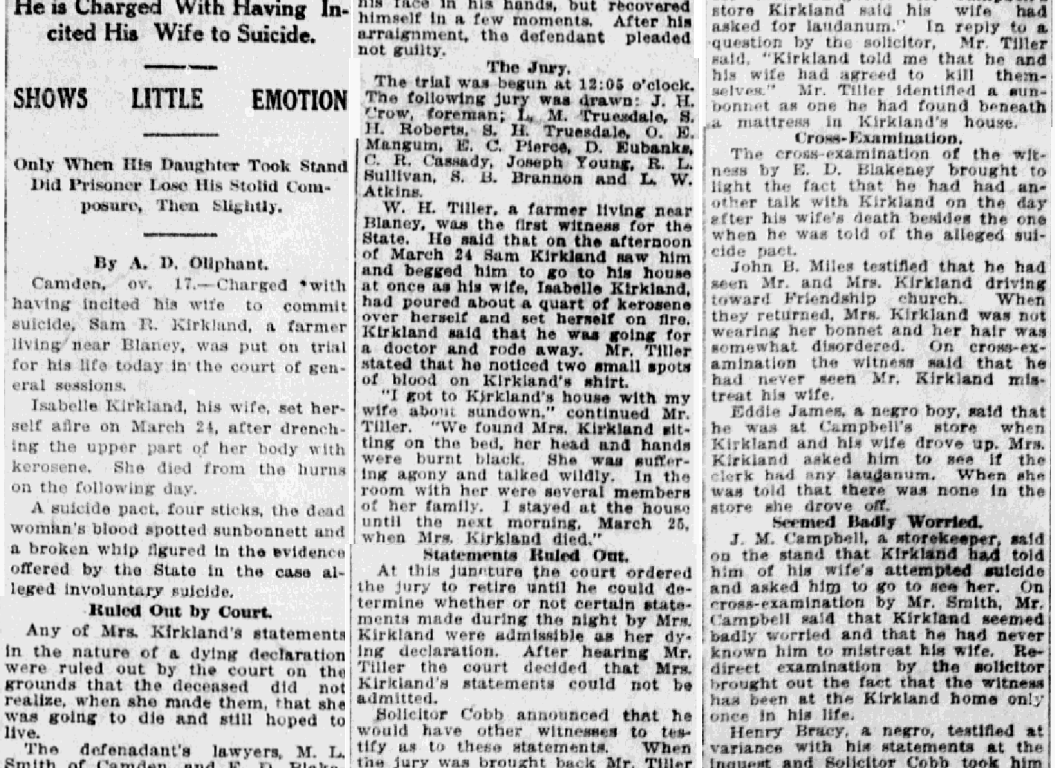
He is Charged with Having Incited His Wife to Suicide.
SHOWS LITTLE EMOTION
Only When His Daughter Took Stand Did Prisoner Lose His Stolid Composure, Then Slightly.
By A. D. Oliphant.
Camden, Nov. 17. – Charged with having incited his wife to commit suicide, Sam R. Kirkland, a farmer living near Blaney, was put on trial for his life today in the court of general sessions.
Isabelle Kirkland, his wife, set herself afire on March 24, after drenching the upper part of her body with kerosene. She died from the burns on the following day.
A suicide pact, four sticks, the dead woman’s blood spotted sunbonnet and a broken whip figured in the evidence offered by the State in the case alleged involuntary suicide.
Ruled Out by Court.
Any of Mrs. Kirkland’s statements in the dature of a dying declaration were ruled out by the court on the grounds that the deceased did not realize, when she made them, that she was going to die and still hoped to live.
The defendant’s lawyers, M. L. Smith of Camden, and E. D. Blakeney of Kershaw, tried to show in their cross-examination that Mr. and Mrs. Kirkland had lived on friendly terms previous to the tragedy.
Thirteen of the 27 witnesses summoned for the State by W. H. Cobb, solicitor of the Seventh judicial district have testified.
Sam R. Kirkland, the defendant in this unusual case, is a middle-aged man. He has iron-gray hair and small, light blue eyes. His face is deep seamed and his hands knotted and rough. He showed no signs of emotion during the trial, except when his eldest daughter, Mary Kirkland, mounted the stand. Then he buried his face in his hands, but recovered himself in a few moments. After his arraignment, the defendant pleaded not guilty.
The Jury.
The trial was begun at 12:05 o’clock. The following jury was drawn: J. H. Crow, foreman; L. M.Truesdale, O. E. Mangum, E. C. Pierce, D. Eubanks, C. R. Cassady, Joseph Young, R. L. Sullivan, S. B. Brannon and L. W. Atkins.
W. H. Tiller, a farmer living near Blaney, was the first witness for the State. He said that on the afternoon of March 24. Sam Kirkland saw him and begged him to go to his house at once as his wife, Isabelle Kirkland, had poured about a quart of Kerosene over herself and set herself on fire, Kirkland said that he was going for a doctor and rode away. Mr. Tiller stated that he noticed two small spots of blood on Kirkland’s shirt.
“I got to Kirkland’s house with my wife about sundown,” continued Mr. Tiller. “We found Mrs. Kirkland sitting on the bed, her head and hands were burnt black. She was suffering agony and talked wildly. In the room with her were several members of her family. I stayed at the house until the next morning, March 25, when Mrs. Kirkland died.”
Statements Ruled Out.
At this juncture the court ordered the jury to retire until he could determine whether or not certain statements made during the night by Mrs. Kirkland were admissible as her dying declaration. After hearing Mr. Tiller the court decided that Mrs. Kirkland’s statements could not be admitted.
Solicitor Cobb announced that he would have other witnesses to testify as to these statements. When the jury was brought back Mr. Tiller continued his testimony. He said that Kirkland did not return home until after his wife died on the morning of March 25.
Picked Out Graves.
“Later in the day.” continued Mr. Tiller, “I had a talk with Kirkland, He told me that on the day his wife tried to kill herself, they had driven in a buggy to Friendship church, where they had picked out three graves, two for themselves and one for their daughter. At Campbell’s store Kirkland said his wife had asked for laudanum.” In reply to a question by the solicitor, Mr. Tiller said, “Kirkland told me that he and his wife had agreed to kill themselves.” Mr. Tiller identified a sunbonnet as one he had found beneath a mattress in Kirkland’s house.
Cross-Examination.
The cross-examination of the witness by E. D. Blakeney brought to light the fact that he had had another talk with Kirkland on the day after his wife’s death besides the one when he told of the alleged suicide pact.
John B. Miles testified that he had seen Mr. and Mrs. Kirkland driving toward Friendship church. When they returned, Mrs. Kirkland was not wearing her bonnet and her hair was somewhat disordered. On cross-examination the witness said that he had never seen Mr. Kirkland mistreat his wife.
Eddie James, a negro boy, said that he was at Campbell’s store when Kirkland and his wife drove up. Mrs. Kirkland asked him to see if the clerk had any laudanum. When she was told that there was none in the store she drove off.
Seemed Badly Worried.
J. M. Campbell, a storekeeper, said on the stand that Kirkland had told him of his wife’s attempted suicide and asked him to go to see her. On cross-examination by Mr. Smith, Mr. Campbell said that Kirkland seemed badly worried and that he had never known him to mistreat his wife. Redirect examination by the solicitor brought out the fact that the witness has been at the Kirkland home only once in his life.
Henry Bracy, a negro, testified at variance with his statements at the inquest and Solicitor Cobb took him off the stand.
Nancy Bracy said that she saw the Kirklands driving home and that Mrs. Kirkland’s face was red.
Alex Belton, a negro, said he saw Kirkland the Monday morning after Mrs. Kirkland’s death. The defense announced that Kirkland was in jail at that time.
W. E. McPherson testified that between 2 and 3 o’clock on the day of Mrs. Kirkland’s death, Kirkland, while accompanied by his wife, had offered him a drink. Mrs. Kirkland, said McPherson on cross-examination, died not seem at all excited.
Minister’s Testimony.
W. J. McPherson, a minister, said that he went to Kirkland’s house, at his request, after his wife had set herself on fire. On cross-examination he said that Kirkland had, to the best of his knowledge, been on friendly terms with his wife.
John L. Motley testified that he went to Friendship church on the Sunday after Mrs. Kirkland died. In walking around over the churchyard, he noticed marks and followed them. A short distance from the buggy track he said he found some broken-up sticks and the prints of a man’s and woman’s shoes, the leaves had been considerably disturbed. Mr. Motley identified four sticks that the solicitor showed him as the ones that he had seen in the churchyard. They were offered in evidence. The witness was submitted to a searching cross-examination by Mr. Blakeney.
Dan McLeod on the stand said that he saw the buggy tracks and the sticks, which he also identified. He stated on cross-examination that the deputy sheriff, Mr. Grimsley, went with him to get the sticks some time afterward.
Brother of Dead Woman.
The brother of the late Mrs. Kirkland, J. F. Goff, said that he reached his sister’s home at 9 o’clock on the night of March 24. At the request of the solicitor, the jury were excluded from the room, and Mr. Goff testified as to his sister’s statements about her nearness to death. After the jury returned Mr. Goff testified that his sister and her husband agreed very well except when he was drinking. Being cross-examined, he said that they “got along about like the average married pair.”
John E. Goff stated that he saw Kirkland on the day after his wife’s death when he had told him that his wife and himself had agreed to commit suicide. She was to have got a bottle of laudanum. Kirkland said he had one in his pocket at the time.
Testimony of Daughter.
Miss Mary Kirkland, Kirkland’s eldest child, testified that when her father got home about midday her mother asked him to take her for a ride. Her mother put on her bonnet and got into the buggy. They did not come back until sundown. When her father got out he struck her sister twice with the broken end of a buggy whip and went into the house with Mrs. Kirkland. Her mother had a scratched place under her chin, and there were a few drops of blood on her bonnet and apron. When her mother went into the house she said, “Don’t you follow me in here?” Soon she saw her with the upper part of her body ablaze. She came running around the side of the house. Her father told her to get a quilt and he put out the fire. The reading of the evidence of Miss Kirkland at the inquest showed that her testimony varied considerably from her statements then.
Among other things she said at the inquest that her father struck her mother with a whip as she was getting out of the buggy. She said on cross-examination that her father was whipping her sister at her mother’s request.
Court adjourned until tomorrow when the case will be resumed.
Columbia, South Carolina
News Article Issue 6977 Page [1], 3
News Article Issue 6977 Page [1], 3