By BIll Higgins
Staff Writer
Emergency Medical technicians (EMT’s) f the Carolina Ambulance Service are receiving new equipment to enable them to treat emergencies in the field.
Two new ambulance have joined the fleet. The new vehicles were authorized two weeks ago by Columbia City Council and cost about $18,000. They are specially constructed and much larger and roomier than the old ambulances, which may be replaced after this fiscal year.
There is now room “to do something for a patient in addition to keeping him alive,” according to operations manager Henry Pettit.
The Ambulance Service said it hopes to purchase more new vehicles and other advanced equipment through grants from the Emergency Medical Services Systems Act of 1974. This act provides $185 million in matching funds to the states to set up units of mobile coronary and trauma care. Although funds are now impounded, money is now coming through the Central Midland Planning Council and the State Board of Health, Pettit said.
The new vehicles meet federal requirements for the interior dimensions needed for advance emergency procedures, according to Pettit. They also provide extra room for equipment.
The two new ambulances have plenty of room to apply procedures in treating coronary and trauma cases. In trauma, an injury throws the body out of balance. Loss of blood and deep shock may result.
New equipment used with advance treatment demands more space. The new ambulances have an electrical oxygen system which provides the exact amount of oxygen a patient needs instantaneously.
The new vehicles are also equipped with “cardio-packs.” These give the advanced EMT a precise monitor of the patient’s heart and can regenerate a heart that is fibrillating or faltering. Columbia has on of the highest incidences of heart disease in the nation, Pettit said.
Neo-natal care equipment in the new vehicles make it possible to give a new infant proper care if it is born before the vehicle reaches the hospital.
EMT’s are also learning to use intravenous medications which may save and prolong life. Dextrose, saline solutions, water and other solutions to replace fluids of a heavily bleeding patient will be standard on the new ambulances. These medications may also stabilized the body, keeping it out of shock.
Officials of the ambulance service credited G. C. Robinett, chairman of the city ambulance committee, with obtaining the improved equipment for the Ambulance Service. Pettit called Robinett the “father of the Emergency Medical Service program in the Columbia area.
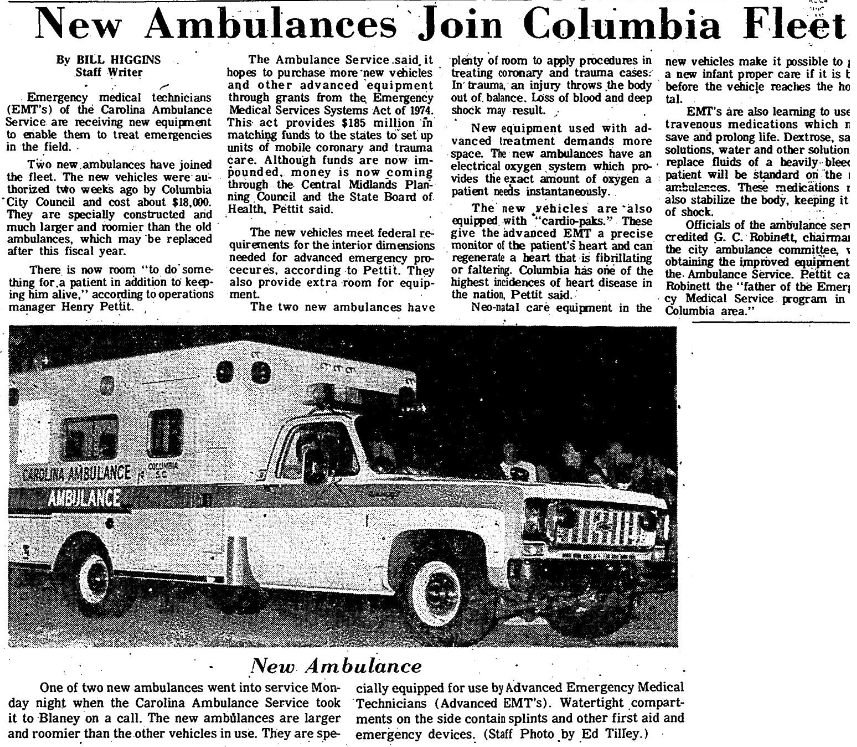
New Ambulance
One of two new ambulances went into service Monday night when the Carolina Ambulance Service took it to Blaney on a call. The new ambulances are larger and roomier than the other vehicles in use. They are specially equipped for use by Advance Emergency Medical Technicians (Advance EMT’s). Watertight compartments on the side contain splints and other first aid and emergency devices. (Staff Photo by Ed Tilley.)
Page 43