September 8, 1988 | State, The (Columbia, SC)Author: Loretta Neal and Jennifer Nicholson, Staff Writers | Page: 1 | Section: NEIGHBORS 2
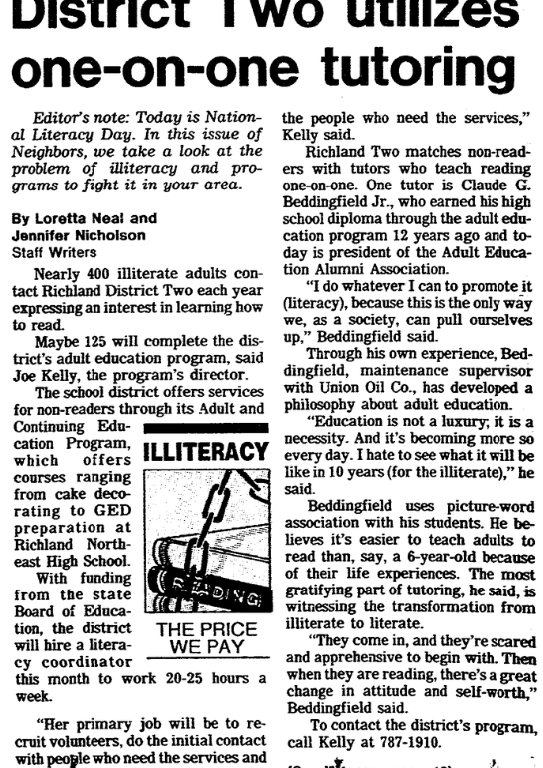
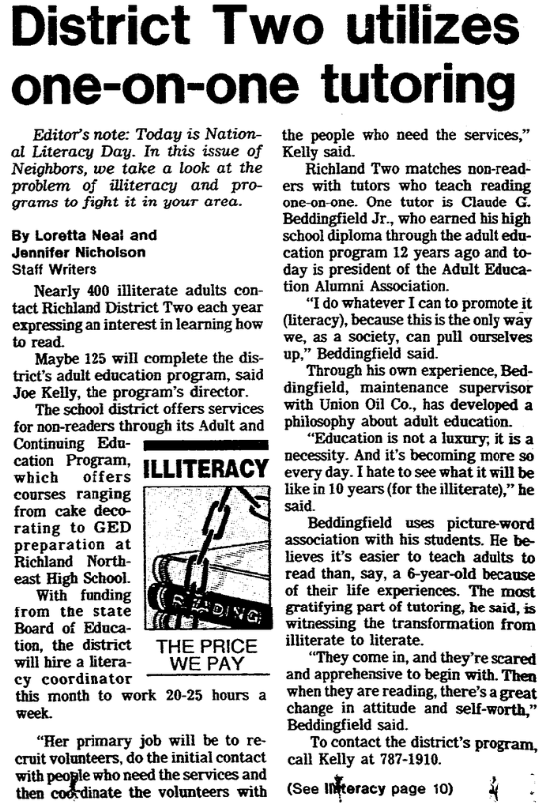
EDITOR’S NOTE: TODAY IS NATIONAL LITERACY DAY. IN THIS ISSUE OF NEIGHBORS, WE TAKE A LOOK AT THE PROBLEM OF ILLITERACY AND PROGRAMS TO FIGHT IT IN YOUR AREA.
Nearly 400 illiterate adults contact Richland District Two each year expressing an interest in learning how to read.
Maybe 125 will complete the district’s adult education program, said Joe Kelly, the program’s director.
The school district offers services for non-readers through its Adult and Continuing Education Program, which offers courses ranging from cake decorating to GED preparation at Richland Northeast High School.
With funding from the state Board of Education, the district will hire a literacy coordinator this month to work 20-25 hours a week.
“Her primary job will be to recruit volunteers, do the initial contact with people who need the services and then coordinate the volunteers with the people who need the services,” Kelly said.
Richland Two matches non-readers with tutors who teach reading one-on- one. One tutor is Claude G. Beddingfield Jr., who earned his high school diploma through the adult education program 12 years ago and today is president of the Adult Education Alumni Association.
“I do whatever I can to promote it (literacy), because this is the only way we, as a society, can pull ourselves up,” Beddingfield said.
Through his own experience, Beddingfield, maintenance supervisor with Union Oil Co., has developed a philosophy about adult education.
“Education is not a luxury; it is a necessity. And it’s becoming more so every day. I hate to see what it will be like in 10 years (for the illiterate),” he said.
Beddingfield uses picture-word association with his students. He believes it’s easier to teach adults to read than, say, a 6-year-old because of their life experiences. The most gratifying part of tutoring, he said, is witnessing the transformation from illiterate to literate.
“They come in, and they’re scared and apprehensive to begin with. Then when they are reading, there’s a great change in attitude and self-worth,” Beddingfield said.
To contact the district’s program, call Kelly at 787-1910.
In the Lugoff-Elgin area, the Kershaw County Schools Adult Education Program offers literacy services at Blaney Elementary School.
The program at Blaney is coordinated through the adult education program to allow a student to begin as a non-reader and continue through the elementary grades, according to Bob Fickling, coordinator of adult programs. Students are taught to read using the Laubach method.
Fickling said the literacy effort was added to the adult education program just last year, but it is an aggressive program that is staffed by teachers and volunteers. Persons may call Kershaw County Vocational Center, 432-9081, after noon.
In Richland County, the Greater Columbia Literacy Council offers a student-tutor program for adults. An estimated 250 new students entered the program in 1987. An equal number of volunteers also were trained through the council as tutors.
The literacy council’s role is to serve as a clearinghouse to involve interested adults in its one-on-one tutoring program, according to Carol Hall, the council’s executive director.
The thrust of the program is to provide personal and private assistance to non-readers or persons wishing to improve their reading skills, Ms. Hall said.
As the program’s overseer, the council matches students with volunteer tutors who are trained to teach reading using the Laubach method, which is based on the “each one-teach one” concept.
An attractive feature of the tutoring program is that the student and tutor determine where tutoring sessions will be held.
The first session, however, is held at the council office at 1715 Bull St.
Sessions can be held anywhere other than the homes of the tutor or student. “We prefer tutoring to be on neutral grounds to avoid interruptions,” Ms. Hall said.
With the Laubach method, tutors use the phonetic approach by concentrating on the sound of words.
“It’s an easy method to teach and to learn, but you can’t expect someone coming in at the first-grade level to start reading at the 12th-grade level,” Ms. Hall said.
Four books of different skill levels are used in the program.
Students are given a certificate after completing each level, and program diplomas are awarded after the completion of all four levels.
On average, students advance from a zero reading level to about a fourth- or fifth-grade level after completing the fourth book. At this point, students are encouraged to enroll in an adult education program, or they may continue to receive tutoring.
Because the council has no way of judging success, goals are not set for the students, Ms. Hall said. One person may realize success after learning to write his or her name, while another may want to complete all reading levels before feeling successful.
Because there is no clear-cut method to reduce illiteracy, there also is not a precise way to determine the actual number of illiterate people in the county.
With this in mind, the literacy council uses as a measuring tool those persons, age 25 and older, who have less than an eighth-grade education, Ms. Hall said.
Based on 1980 U.S. Bureau of Census figures, it is estimated that 22,867 adults in Richland County had less than an eighth-grade education. The county had an adult population in those age ranges of 144,197.
“You have to realize the inaccuracy of this because we have some people with an eighth-grade education who can read fine, and there are some college students who can’t read at all,” Ms. Hall said.
Reading is a skill that must be used, no matter when it is learned, if it is to be maintained, according to Ms. Hall.
In general, people will read three to five grade levels below the last grade completed in school, she said.
“There is a broad generalization that people tend to lose grade levels if they are in a job that does not require reading,” Ms. Hall said.
On the other hand, reading levels will increase if the skill is used regularly.
The literacy council was organized in 1968. To celebrate its 20th anniversary, the agency has planned a number of programs that will continue into 1989.
In addition to Richland County, the council also serves Lexington, Newberry and Fairfield counties.
Persons interested in learning to read can contact the council office Monday through Friday from 10 a.m. to 3 p.m. by calling 765-2555.
Columbia, South Carolina
Page 67
Page 76