The two-acre lot in Elgin appealed to Lisa and Rufus McDaniel, but their “Little House on the Prairie” dream has turned into a legal nightmare.
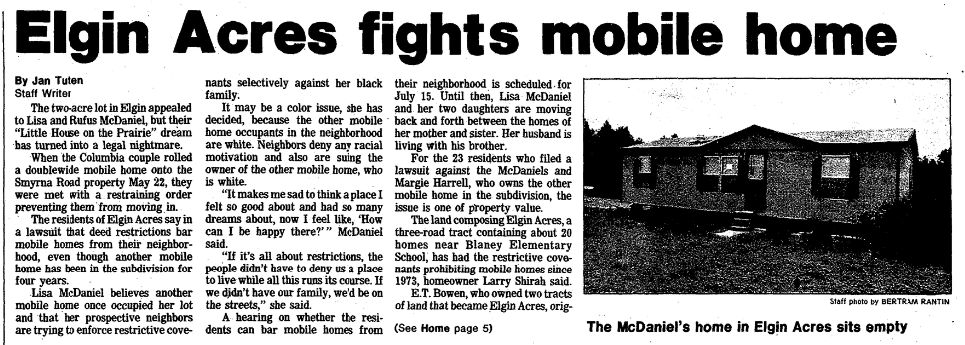
When the Columbia couple rolled a doublewide mobile home onto the Smyrna Road property May 22, they were met with a restraining order preventing them from moving in.
The residents of Elgin Acres say in a lawsuit that deed restrictions bar mobile homes from their neighborhood, even though another mobile home has been in the subdivision for four years.
Lisa McDaniel believes another mobile home once occupied her lot and that her prospective neighbors are trying to enforce restrictive covenants selectively against her black family.
It may be a color issue, she has decided, because the other mobile home occupants in the neighborhood are white. Neighbors deny any racial motivation and also are suing the owner of the other mobile home, who is white.
“It makes me sad to think a place I felt so good about and had so many dreams about, now I feel like, ‘How can I be happy there?’ ” McDaniel said.
“If it’s all about restrictions, the people didn’t have to deny us a place to live while all this runs its course. If we didn’t have our family, we’d be on the streets,” she said.
A hearing on whether the residents can bar mobile homes from their neighborhood is scheduled for July 15. Until then, Lisa McDaniel and her two daughters are moving back and forth between the homes of her mother and sister. Her husband is living with his brother.
For the 23 residents who filed a lawsuit against the McDaniels and Margie Harrell, who owns the other mobile home in the subdivision, the issue is one of property value.
The land composing Elgin Acres, a three-road tract containing about 20 homes near Blaney Elementary School, has had the restrictive covenants prohibiting mobile homes since 1973, homeowner Larry Shirah said.
E.T. Bowen, who owned two tracts of land that became Elgin Acres, originally placed the restrictions on the property when he sold it to Lem Wooten in 1973. Wooten passed on the restrictions to each property owner when he carved up the land into lots.
Shirah said the McDaniels were told by letter and orally that mobile homes were prohibited on the lot, located at the entrance of the subdivision.
“The McDaniels have known about the restrictions since three days after their closing (in December), and they’ve ignored it,” Shirah said.
The racial issue is “absolutely ridiculous,” Shirah said, noting that two black families rent homes in the neighborhood. One black homeowner is among the 23 residents who filed suit against the Columbia couple, he said.
Residents were forced to file suit to enforce the covenants, he said, because Kershaw County’s planning and zoning department has no enforcement authority over subdivision restrictions.
And the Harrells’ mobile home, in the backyard of their primary residence and visible from only about two homes, was supposed to be there only temporarily, he said.
The home is occupied by a daughter and her husband. Harrell lives in the house on the property.
Homeowners had protested the existing mobile home but had not taken legal action because one family member was seriously ill, Shirah said.
But homeowners felt they had warned the McDaniels of the restrictions and that the couple paid no heed, he said.
“Our property values will go through the floor, and they simply do not care. We did everything in the world to prevent this, but they’ve basically ignored us. They’re still welcome there if they want to build,” Shirah said.
Lisa McDaniel, too, said she feels she made every effort to make sure mobile homes would be allowable. McDaniel said she relied on advice given by their closing attorney, Brian Reeve.
Reeve said he was not aware the McDaniels intended to move a mobile home onto the property until after the closing. But he had learned that a mobile home once was on the property.
Wooten, the developer of Elgin Acres, said a homeowner did move a mobile home onto the site temporarily after his house burned. Wooten did not know how long the mobile home stayed there or when it was moved.
McDaniel points to two metal structures that aren’t single-family dwellings in the subdivision as evidence of unfair enforcement. One resident also keeps junk cars on his property, she said.
An inspector approved the location of her mobile home, she noted. Planning and zoning accepted the fees they paid to have the mobile home moved there, she added. Elgin Acres also wasn’t listed in the clerk of court’s subdivision ledger, so she felt she was being misled by residents’ assertions.
“Nobody was giving us evidence to support what the neighbors were saying,” she said.
“I just think the whole thing has been done unfairly. Why, if in fact it’s all about restrictions, why enforce them now? Why now? Why put us through the misery?”
Columbia, South Carolina
Page 57