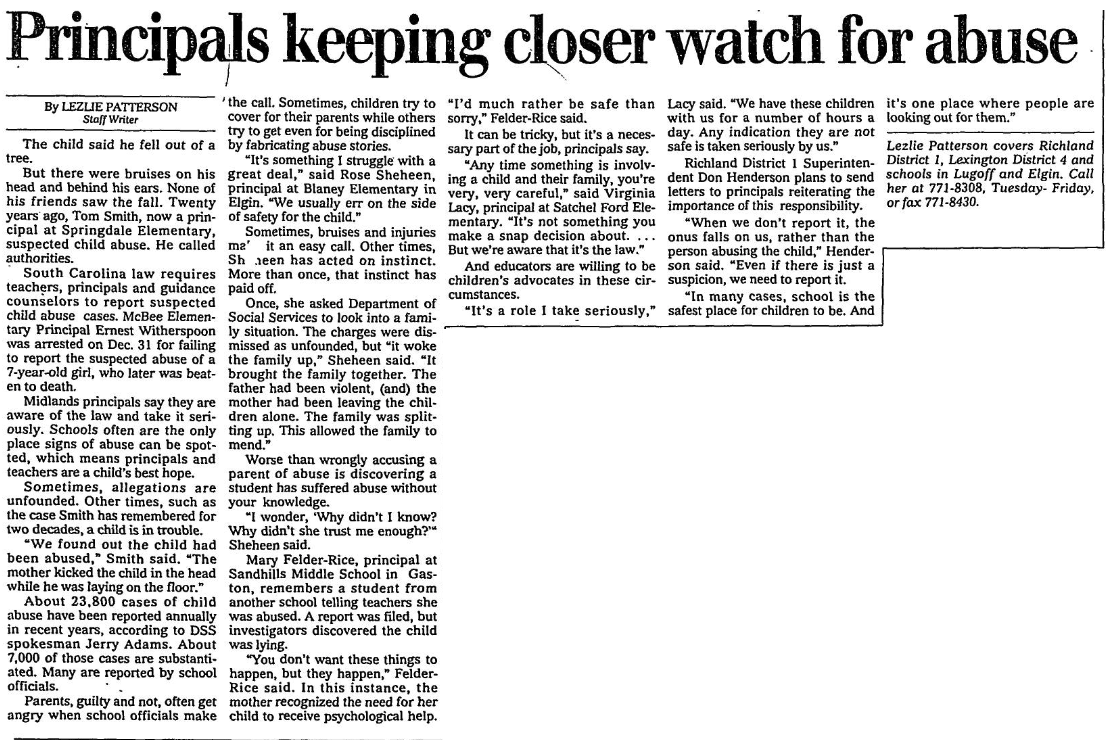
The child said he fell out of a tree.
But there were bruises on his head and behind his ears. None of his friends saw the fall. Twenty years ago, Tom Smith, now a principal at Springdale Elementary, suspected child abuse. He called authorities.
South Carolina law requires teachers, principals and guidance counselors to report suspected child abuse cases. McBee Elementary Principal Ernest Witherspoon was arrested on Dec. 31 for failing to report the suspected abuse of a 7- year-old girl, who later was beaten to death.
Midlands principals say they are aware of the law and take it seriously. Schools often are the only place signs of abuse can be spotted, which means principals and teachers are a child’s best hope.
Sometimes, allegations are unfounded. Other times, such as the case Smith has remembered for two decades, a child is in trouble.
“We found out the child had been abused,” Smith said. “The mother kicked the child in the head while he was laying on the floor.”
About 23,800 cases of child abuse have been reported annually in recent years, according to DSS spokesman Jerry Adams. About 7,000 of those cases are substantiated. Many are reported by school officials.
Parents, guilty and not, often get angry when school officials make the call. Sometimes, children try to cover for their parents while others try to get even for being disciplined by fabricating abuse stories.
“It’s something I struggle with a great deal,” said Rose Sheheen, principal at Blaney Elementary in Elgin. “We usually err on the side of safety for the child.”
Sometimes, bruises and injuries make it an easy call. Other times, Sheheen has acted on instinct. More than once, that instinct has paid off.
Once, she asked Department of Social Services to look into a family situation. The charges were dismissed as unfounded, but “it woke the family up,” Sheheen said. “It brought the family together. The father had been violent, (and) the mother had been leaving the children alone. The family was splitting up. This allowed the family to mend.”
Worse than wrongly accusing a parent of abuse is discovering a student has suffered abuse without your knowledge.
“I wonder, ‘Why didn’t I know? Why didn’t she trust me enough?’ ” Sheheen said.
Mary Felder-Rice, principal at Sandhills Middle School in Gaston, remembers a student from another school telling teachers she was abused. A report was filed, but investigators discovered the child was lying.
“You don’t want these things to happen, but they happen,” Felder-Rice said. In this instance, the mother recognized the need for her child to receive psychological help. “I’d much rather be safe than sorry,” Felder-Rice said.
It can be tricky, but it’s a necessary part of the job, principals say.
“Any time something is involving a child and their family, you’re very, very careful,” said Virginia Lacy, principal at Satchel Ford Elementary. “It’s not something you make a snap decision about. . . . But we’re aware that it’s the law.”
And educators are willing to be children’s advocates in these circumstances.
“It’s a role I take seriously,” Lacy said. “We have these children with us for a number of hours a day. Any indication they are not safe is taken seriously by us.”
Richland District 1 Superintendent Don Henderson plans to send letters to principals reiterating the importance of this responsibility.
“When we don’t report it, the onus falls on us, rather than the person abusing the child,” Henderson said. “Even if there is just a suspicion, we need to report it.
“In many cases, school is the safest place for children to be. And it’s one place where people are looking out for them.”
Lezlie Patterson covers Richland District 1, Lexington District 4 and schools in Lugoff and Elgin. Call her at 771-8308, Tuesday- Friday, or fax 771-8430.
Page 7