By ROB REYNOLDLS
More than three decades ago, the town of Blaney had its first Kodak moment when the Elgin Watch Co. and the State Development Board jointly announced the construction of a new factory.
Overwhelmed by their good fortune, the town voted to change its name to Elgin, in honor of the occasion.
The State Development Board had recruited another out-of-state industry by luring them here with promises of such low taxes for several years that it would be difficult for any company to turn the offer down. A few citizens questioned the wisdom of the Development Board’s recruitment policy, suggesting the establishment of a watchdog agency to oversee these operations, to assure that no damage came to the community or the environment.
The Doubting Thomases pointed out that unfettered recruitment had a down side, if there were no safeguards to prevent unscrupulous captains of industry from taking advantages of us. These voices in the wilderness went unheeded, construction began, and the town blossomed under the benevolent eye of its new corporate partner.
The dedication ceremony included state officials and other VIPs. Some dignitaries were presented with complimentary watches.
Several years witnessed the influx of people who came to work at the factory and the buisness they generated.
One morning, the company quietly announced its move back to Waterbury, Conn.
The town gasped.
Citizens concluded the company came here under false pretenses, taking advantage of the tax credits and cheap labor. Naysayers’ earlier warning echoed like distant thunder, as displaced workers and their families pondered their fate. Homes were lost. Bank accounts dried up. A pall hung over the town like a cloud of spiritual pollution.
The windows of the vacated factory reflected the emptiness of the company’s commitment and the pathetic mess of pottage for which the town relinquished its birthright.
To their credit, they didn’t restore the town name; they’d live with their mistake.
One need to look no further for proof of the continued failure of the Development Board to screen incoming industry more carefully or DHEC’s preparedness to deal with physical pollution that the incidents occurring in Chapin several years ago. Suffolk Chemical Co. twice released toxic gas into the atmosphere, requiring evacuations of the town. Later, it was learned they also polluted the groundwater and a nearby stream which feeds into Lake Murray. That company left when its tax credit (and welcome) ran out, but where was DHEC when the townspeople complained? Why was the pollution allowed to recur?
The laundry in a poor residential area off Rosewood Drive, which cleans uniforms contaminated with radioactivity; how long would DHEC have allowed this to continue if the newspaper had not pressed for action?
Where was the agency two decades ago, when businesses in Red Bank polluted the groundwater with industrial chemicals and then moved on? Weren’t those people entitled to some protection?
DHEC claims it may take a long time to determined who caused this ecological mess. Why is it taking so long? Did they not have the capability to monitor the business and keep adequate records, so they can determine who did it? If not, why not?
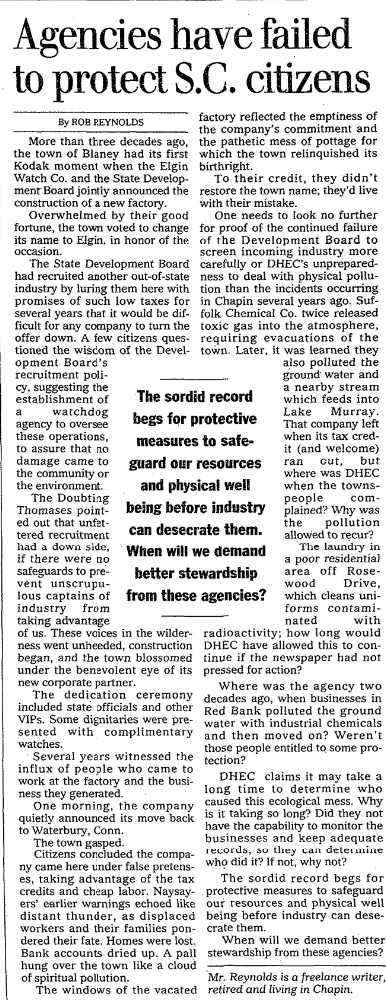
The sordid record begs for protective measures to safeguard our resources and physical well being before industry can desecrate them.
When will we demand better stewardship from these agencies?
Mr. Reynolds is a freelance writer, retired and living in Chapin.
Columbia, South Carolina
Page 11