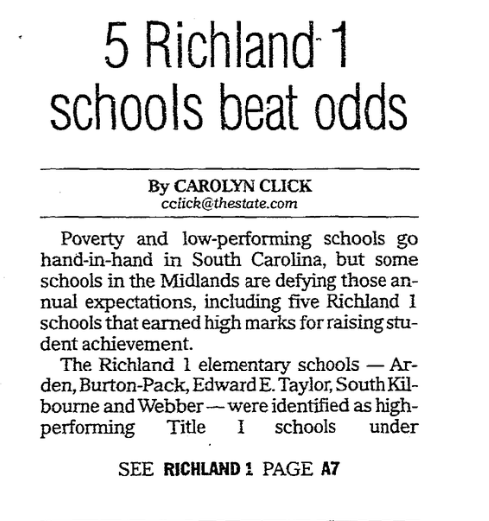
Poverty and low-performing schools go hand-in-hand in South Carolina, but some schools in the Midlands are defying those annual expectations, including five Richland 1 schools that earned high marks for raising student achievement.
The Richland 1 elementary schools – Arden, Burton-Pack, Edward E. Taylor, South Kilbourne and Webber – were identified as high-performing Title I schools under
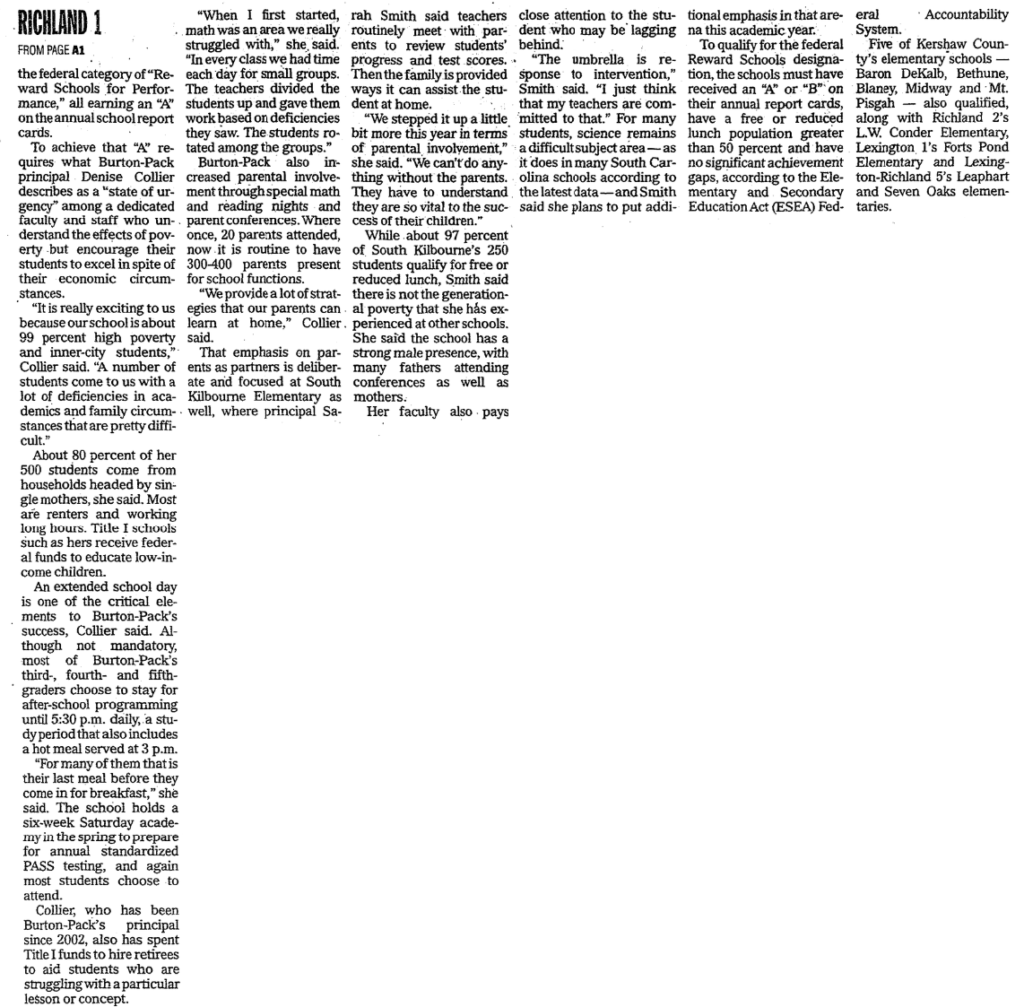
the federal category of “Reward Schools for Performance,” all earning an “A” on the annual school report cards.
To achieve that “A” requires what Burton-Pack principal Denise Collier describes as a “state of urgency” among a dedicated faculty and staff who understand the effects of poverty but encourage their students to excel in spite of their economic circumstances.
“It is really exciting to us because our school is about 99 percent high poverty and inner-city students,” Collier said. “A number of students come to us with a lot of deficiencies in academics and family circumstances that are pretty difficult.”
About 80 percent of her 500 students come from households headed by single mothers, she said. Most are renters and working long hours. Title I schools such as hers receive federal funds to educate low-income children.
An extended school day is one of the critical elements to Burton-Pack’s success, Collier said. Although not mandatory, most of Burton-Pack’s third-, fourth- and fifth-graders choose to stay for after-school programming until 5:30 p.m. daily, a study period that also includes a hot meal served at 3 p.m.
“For many of them that is their last meal before they come in for breakfast,” she said. The school holds a six-week Saturday academy in the spring to prepare for annual standardized PASS testing, and again most students choose to attend.
Collier, who has been Burton-Pack’s principal since 2002, also has spent Title I funds to hire retirees to aid students who are struggling with a particular lesson or concept.
“When I first started, math was an area we really struggled with,” she said. “In every class we had time each day for small groups. The teachers divided the students up and gave them work based on deficiencies they saw. The students rotated among the groups.”
Burton-Pack also increased parental involvement through special math and reading nights and parent conferences. Where once, 20 parents attended, now it is routine to have 300-400 parents present for school functions.
“We provide a lot of strategies that our parents can learn at home,” Collier said.
That emphasis on parents as partners is deliberate and focused at South Kilbourne Elementary as well, where principal Sarah Smith said teachers routinely meet with parents to review students’ progress and test scores. Then the family is provided ways it can assist the student at home.
“We stepped it up a little bit more this year in terms of parental involvement,” she said. “We can’t do anything without the parents. They have to understand they are so vital to the success of their children.”
While about 97 percent of South Kilbourne’s 250 students qualify for free or reduced lunch, Smith said there is not the generational poverty that she has experienced at other schools. She said the school has a strong male presence, with many fathers attending conferences as well as mothers.
Her faculty also pays close attention to the student who may be lagging behind.
“The umbrella is response to intervention,” Smith said. “I just think that my teachers are committed to that.” For many students, science remains a difficult subject area – as it does in many South Carolina schools according to the latest data – and Smith said she plans to put additional emphasis in that arena this academic year.
To qualify for the federal Reward Schools designation, the schools must have received an “A” or “B” on their annual report cards, have a free or reduced lunch population greater than 50 percent and have no significant achievement gaps, according to the Elementary and Secondary Education Act (ESEA) Federal Accountability System.
Five of Kershaw County’s elementary schools – Baron DeKalb, Bethune, Blaney, Midway and Mt. Pisgah – also qualified, along with Richland 2’s L.W. Conder Elementary, Lexington 1’s Forts Pond Elementary and Lexington-Richland 5’s Leaphart and Seven Oaks elementaries.
Page 1
Page 7