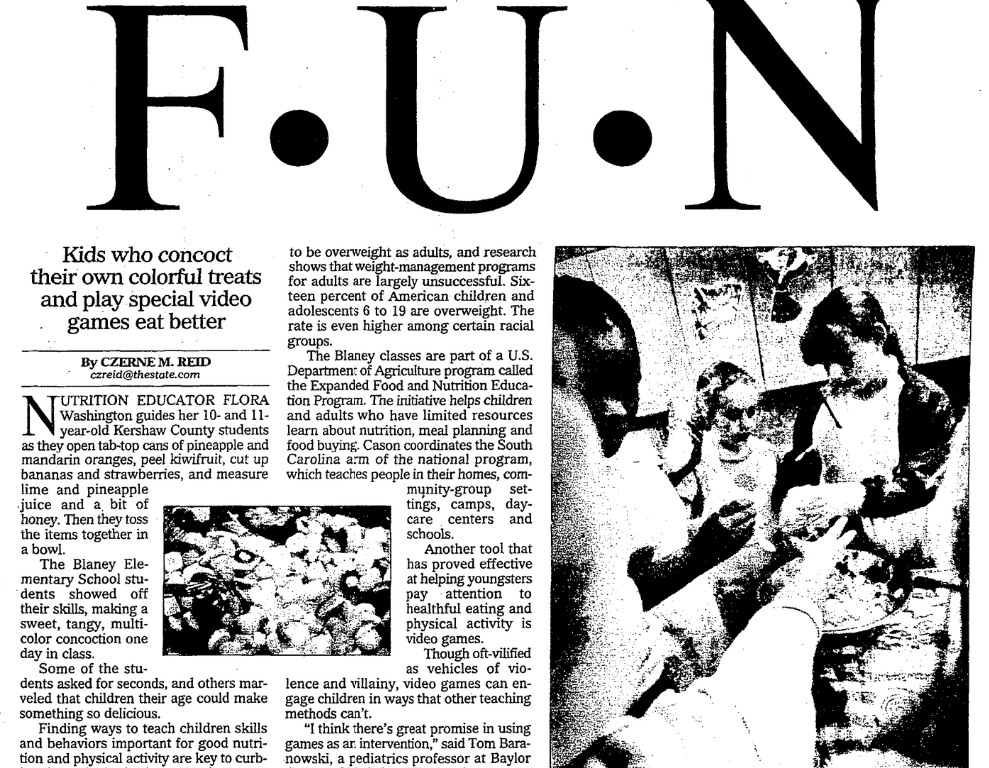
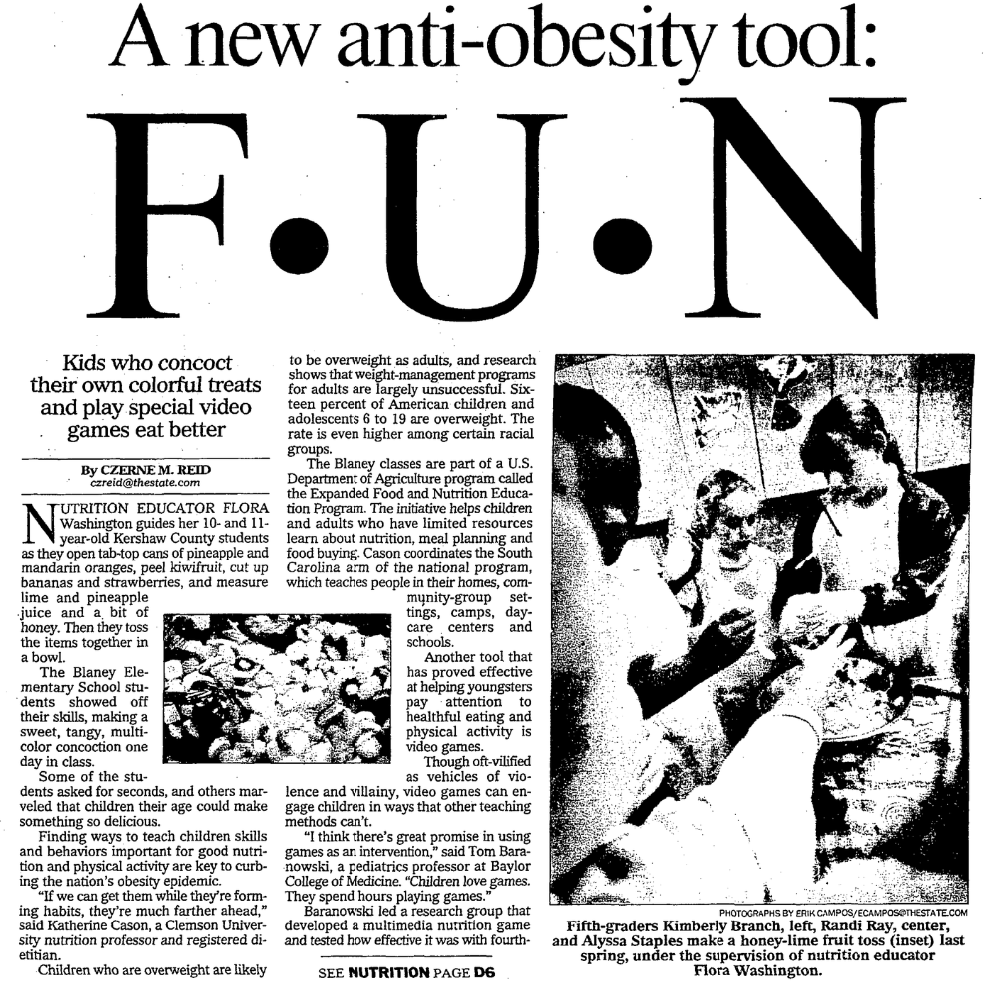
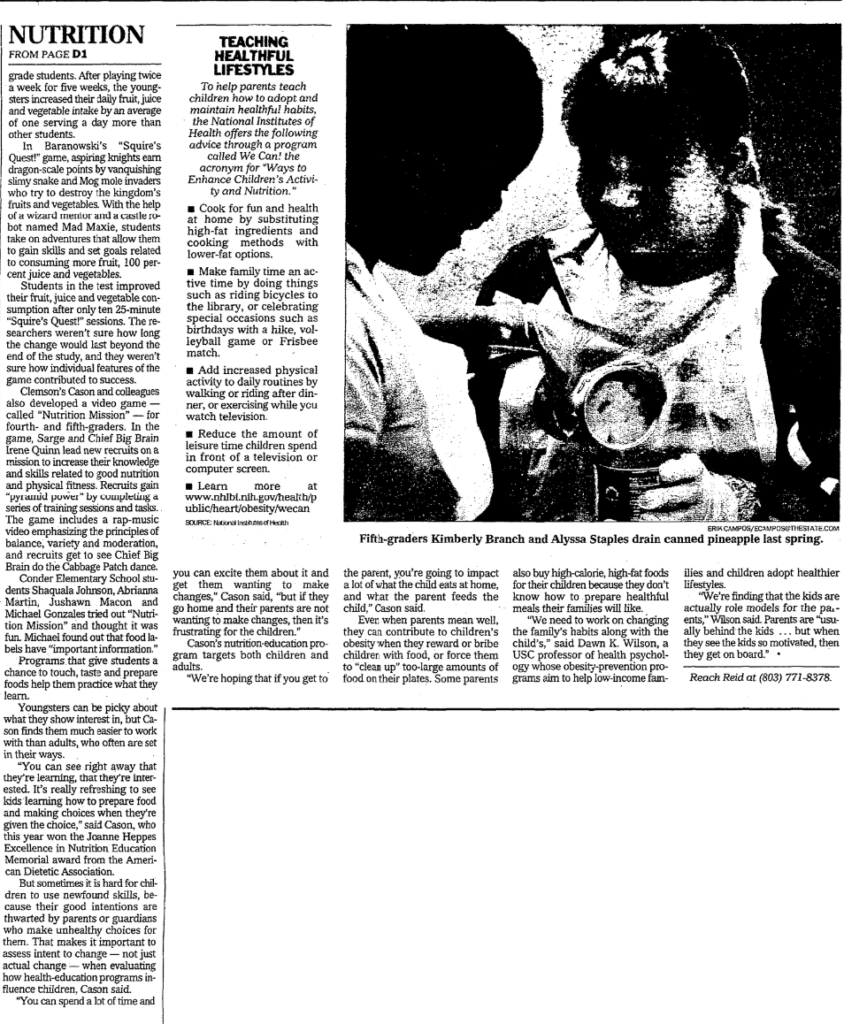
Nutrition educator Flora Washington guides her 10- and 11-year-old Kershaw County students as they open tab-top cans of pineapple and mandarin oranges, peel kiwifruit, cut up bananas and strawberries, and measure lime and pineapple juice and a bit of honey. Then they toss the items together in a bowl.
The Blaney Elementary School students showed off their skills, making a sweet, tangy, multicolor concoction one day in class.
Some of the students asked for seconds, and others marveled that children their age could make something so delicious.
Finding ways to teach children skills and behaviors important for good nutrition and physical activity are key to curbing the nation’s obesity epidemic.
“If we can get them while they’re forming habits, they’re much farther ahead,” said Katherine Cason, a Clemson University nutrition professor and registered dietitian.
Children who are overweight are likely to be overweight as adults, and research shows that weight-management programs for adults are largely unsuccessful. Sixteen percent of American children and adolescents 6 to 19 are overweight. The rate is even higher among certain racial groups.
The Blaney classes are part of a U.S. Department of Agriculture program called the Expanded Food and Nutrition Education Program. The initiative helps children and adults who have limited resources learn about nutrition, meal planning and food buying. Cason coordinates the South Carolina arm of the national program, which teaches people in their homes, community-group settings, camps, daycare centers and schools.
Another tool that has proved effective at helping youngsters pay attention to healthful eating and physical activity is video games.
Though oft-vilified as vehicles of violence and villainy, video games can engage children in ways that other teaching methods can’t.
“I think there’s great promise in using games as an intervention,” said Tom Baranowski, a pediatrics professor at Baylor College of Medicine. “Children love games. They spend hours playing games.”
Baranowski led a research group that developed a multimedia nutrition game and tested how effective it was with fourth-grade students. After playing twice a week for five weeks, the youngsters increased their daily fruit, juice and vegetable intake by an average of one serving a day more than other students.
In Baranowski’s “Squire’s Quest!” game, aspiring knights earn dragon-scale points by vanquishing slimy snake and Mog mole invaders who try to destroy the kingdom’s fruits and vegetables. With the help of a wizard mentor and a castle robot named Mad Maxie, students take on adventures that allow them to gain skills and set goals related to consuming more fruit, 100 percent juice and vegetables.
Students in the test improved their fruit, juice and vegetable consumption after only ten 25-minute “Squire’s Quest!” sessions. The researchers weren’t sure how long the change would last beyond the end of the study, and they weren’t sure how individual features of the game contributed to success.
Clemson’s Cason and colleagues also developed a video game – called “Nutrition Mission” – for fourth- and fifth-graders. In the game, Sarge and Chief Big Brain Irene Quinn lead new recruits on a mission to increase their knowledge and skills related to good nutrition and physical fitness. Recruits gain “pyramid power” by completing a series of training sessions and tasks. The game includes a rap-music video emphasizing the principles of balance, variety and moderation, and recruits get to see Chief Big Brain do the Cabbage Patch dance.
Conder Elementary School students Shaquala Johnson, Abrianna Martin, Jushawn Macon and Michael Gonzales tried out “Nutrition Mission” and thought it was fun. Michael found out that food labels have “important information.”
Programs that give students a chance to touch, taste and prepare foods help them practice what they learn.
Youngsters can be picky about what they show interest in, but Cason finds them much easier to work with than adults, who often are set in their ways.
“You can see right away that they’re learning, that they’re interested. It’s really refreshing to see kids learning how to prepare food and making choices when they’re given the choice,” said Cason, who this year won the Joanne Heppes Excellence in Nutrition Education Memorial award from the American Dietetic Association.
But sometimes it is hard for children to use newfound skills, because their good intentions are thwarted by parents or guardians who make unhealthy choices for them. That makes it important to assess intent to change – not just actual change – when evaluating how health-education programs influence children, Cason said.
“You can spend a lot of time and you can excite them about it and get them wanting to make changes,” Cason said, “but if they go home and their parents are not wanting to make changes, then it’s frustrating for the children.”
Cason’s nutrition-education program targets both children and adults.
“We’re hoping that if you get to the parent, you’re going to impact a lot of what the child eats at home, and what the parent feeds the child,” Cason said.
Even when parents mean well, they can contribute to children’s obesity when they reward or bribe children with food, or force them to “clean up” too-large amounts of food on their plates. Some parents also buy high-calorie, high-fat foods for their children because they don’t know how to prepare healthful meals their families will like.
“We need to work on changing the family’s habits along with the child’s,” said Dawn K. Wilson, a USC professor of health psychology whose obesity-prevention programs aim to help low-income families and children adopt healthier lifestyles.
Children do have influence on their parents.
“We’re finding that the kids are actually role models for the parents,” Wilson said. Parents are “usually behind the kids . . . but when they see the kids so motivated, then they get on board.”
Reach Reid at (803) 771-8378.
TEACHING HEALTHFUL LIFESTYLES
To help parents teach children how to adopt and maintain healthful habits, the National Institutes of Health offers the following advice through a program called We Can! the acronym for “Ways to Enhance Children’s Activity and Nutrition.”
* Cook for fun and health at home by substituting high-fat ingredients and cooking methods with lower-fat options.
* Make family time an active time by doing things such as riding bicycles to the library, or celebrating special occasions such as birthdays with a hike, volleyball game or Frisbee match.
* Add increased physical activity to daily routines by walking or riding after dinner, or exercising while you watch television.
* Reduce the amount of leisure time children spend in front of a television or computer screen.
* Learn more at www.nhlbi.nih.gov/health/public/heart/obesity/wecan
SOURCE: National Institutes of Health
Columbia, South Carolina
Page 39
Columbia, South Carolina
Page 44