By MICHELLE R. DAVIS
Camden Bureau
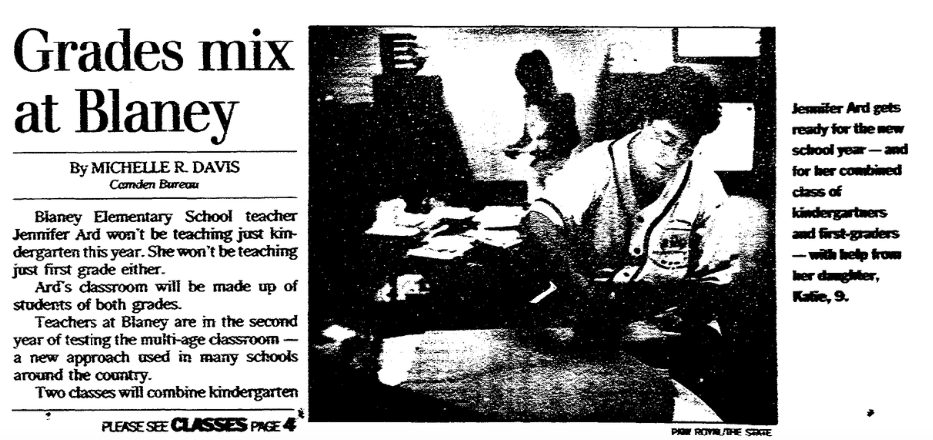
Blaney Elementary School teacher Jennifer Ard won’t be teaching just kindergarten this year. She won’t be teaching just first grade either.
Ard’s classroom will be made up of student of both grades.
Teachers at Blaney are in the second year of testing the multi-age classroom- a new approach used in many schools around the country.
Two classes will combine kindergarten and first-graders, and two other will group second and third-grade students together.
The intent is to group the younger, faster learners with older kids who need additional help with material, said school Principal Rose Sheheen.
“Chronological age is no more accurate at predicting a child’s achievement ability than shoe size,” Sheheen said. “We force children to move at the pace we move.”
The idea of a multi-age classroom has been around for decades, said Marguerite Bellringer, coordinator of the National alliance for Multi-Age Educators.
“In a way it was here years ago with the little red schoolhouse,” she said.
Now states like Kentucky mandate multi-age classrooms on the elementary level, and the technique is widely used in Michigan, Washington state and California, Bellringer said.
Students’ environments and experiences – such as living in a single-parent family – affect their learning abilities, Bellringer said. The multi-age class allows them to work at their own speed.
The setup also lets kids work together, Bellringer said.
When Tracey Bench taught one of the second/third grade classes at Blaney last year, she often saw older students helping younger ones. Bench said she believes the second-graders learned more than they would have in a regular classroom.
“It really challenged them to keep up with the older kids and think,” she said. “And I didn’t” slow it down at all for the third-graders. It gave them a chance to the be the leaders in the class.”
There is no stigma connected to being in one of these multi-age classes, as there can be when a child is held back a grade, Bench said. After a while, the students “stop focusing on who’s in what grade,” she said.
Sheheen said she also saw a decrease in discipline problems last year, with older children encouraging the younger ones to behave. The classes created a peer group similar to a family with siblings of different ages, she said.
Ard visited several schools that use multi-age classrooms to prepare for teaching this year. She believes the multi-age approach will help teacher meet students’ needs.
Columbia, South Carolina
Page 69
Columbia, South Carolina
Page 72