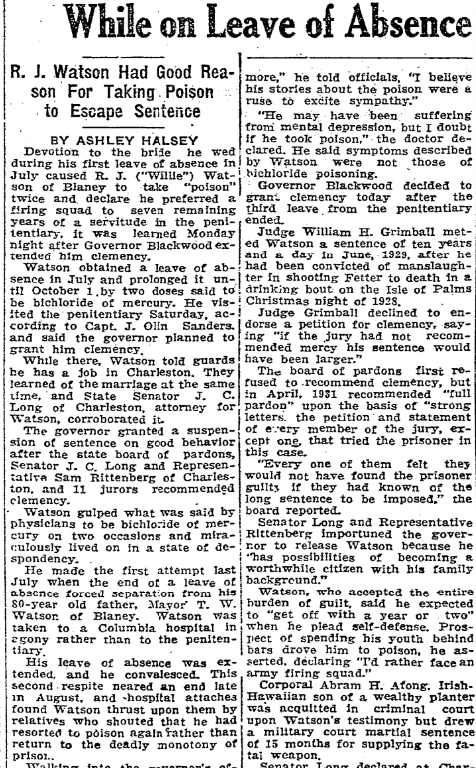
R. J. Watson Had Good Reason For Taking Poison to Escape Sentence
BY ASHLEY HALSEY
Devotion to the bride he went during his first leave of absence in July caused R. J. (“Willie”) Watson of Blaney to take “poison” twice and declare he preferred a firing squad to seven remaining years of a servitude in the penitentiary, it was learned Monday night after Governor Blackwood extended him clemency.
Watson obtained a leave of absence in July and prolonged it until October 1, by two doses said to be bichloride of mercury. He visited the penitentiary Saturday, according to Capt. J. Olin Sanders, and said the governor planned to grant him clemency.
While there, Watson told guards he has a job in Charleston. They learned of the marriage at the same time, and State Senator J. C. Long of Charleston, attorney for Watson, corroborated it.
The governor granted a suspension of sentence on good behavior after the state board of pardons, Senator J. C. Long and Representative Sam Rittenberg of Charleston, and 11 jurors recommended clemency.
Watson gulped what was said by physicians to be bichloride of mercury on two occasions and miraculously lived on in a state of despondency.
He made the first attempt last July when the end of a leave of absence forced separation from his 80-year old father, Mayor T. W. Watson of Blaney. Watson was taken to a Columbia hospital in agony rather than to the penitentiary.
His leave of absence was extended, and he convalesce. This second respite neared an end late in August, and hospital attached found Watson thrust upon them by relatives who shouted that he had resorted to poison again rather than return to the deadly monotony of prison.
Walking into the governor’s office after recovery from this dose, Watson informed the state executive, “I’m crazy. If you don’t believe it, have be examined.”
Dr. C. Fred Williams, superintendent of the state hospital, reported after the examination that Watson possessed full sanity. “Furthermore,” he told officials, “I believe his stories about the poison were a ruse to excite sympathy.”
“He may have been suffering from mental depression, but I doubt if he took poison,” the doctor declared. He said symptoms described by Watson were not those of bichloride poisoning.
Governor Blackwood decided to grant clemency today after the third leave from the penitentiary ended.
Judge William H. Grimball meted Watson a sentence of ten years and a day in June, 1929, after he had been convicted of manslaughter in shooting Fetter to death in a drinking bout on the Isle of Palms Christmas night of 1928.
Judge Grimball declined to endorse a petition for clemency, saying “if the jury had not recommended mercy his sentence would have been larger.”
The board of pardon first refused to recommend clemency, but in April, 1931 recommended “full pardon” upon the basis of “strong letters the petition and statement of every member of the jury, except one, that tried the prisoner in this case.
“Every one of them felt they would not have found the prisoner guilty if they had known of the long sentence to be imposed.” the board reported.
Senator Long and Representative Rittenberg importuned the governor to release Watson because he “has possibilities of becoming a worthwhile citizen with his family background.”
Watson, who accepted the entire burden of guilt, said he expected to “get off with a year or two” when he plead self-defense. Prospect of sending his youth behind bars drove him to poison, he asserted, declaring “I’d rather face an army firing squad.”
Corporal Abram H. Afong, Irish-Hawaiian son of a wealthy planter was acquitted in criminal court upon Watson’s testimony but drew a military court martial sentence of 15 months for supplying the fatal weapon.
Senator Long declared at Charleston that Afong has married also since the widow of the slain soldier wed a comrade of his at for Moultrie.
He said the twelfth juror could not be reached to join in the petition for clemency.
Columbia, South Carolina
Page 11