Written for “The State” by Dr. Edwin L. Green
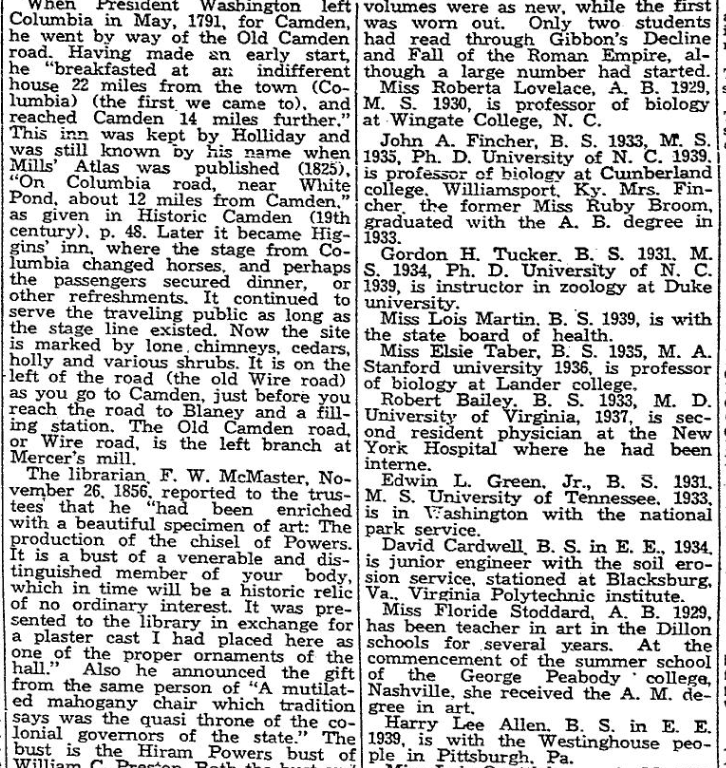
Wshen President Washing left columbia in May, 1791, for Camden, he went by way of the Old Camden road. Having made an early start, he “breakfasted at an indifferent house 22 miles from the town (Columbia) the first we came to), and reached Camden 14 miles futher.” This inn was kept by Holliday and was still known by his name when Mills’ Atlas was published (1825), “On Columbia road, near White Pond, about 12 miles from Camden.” as given in Historic Camden (19th century), p. 48. Later it became Higgins’ Inn, where the stage from Columbia changed horses, and perhaps the passengers secured diner, or other refreshments. It continued to serve the traveling public as long as the stage line existed. Now the site is marked by lone chimneys, cedars, holly and various shrubs. It is on the left of the road (the old Wire road) as you go to Camden, just before your reach the road to Blaney and a filling station. The old Camden road, or Wire road, is the left branch at Mercer’s mill.
The librarian, F. W. McMaster, November 26, 1856, reported to the trustees that he “had been enriched with a beautiful specimen of art; The production of the chise of Powers. It is a bust of a venerable and distinguished member of your body, which in time will be a historic relic of no ordinary interest. It was presented to the library in exchange for a plaster cast I had placed here as one o the proper ornaments of the hall.” Also he announced the gift from the same person of “A mutilated mahogany chair which tradition says was the quasi throne of the colonial governors of the state.” The bust is the Hiram Powers bust of William C. Preston. Both the bust and the chair are in the library.
Mr. McMaster commented on the lack of persistence of many readers, who would begin a large work and after reading through the first volume give up, so that it often happens in the larger sets the other volumes were as new, while the first was worn out. Only two students had read through Gibbon’s Decline and Fall of the Roman Empire, although a large number had started.
Miss Roberta Lovelace, A. B. 1929, M. S. 1930, is professor of biology at Wingate College, N. C.
John A. Fincher, B. S. 1933, M. S. 1935, Ph. D. University of N. C. 1939, is professor of biology at Cumberland college. Williamsport, Ky. Mrs. Fincher the former Miss Ruby Broom, graduated with the A. B. degree in 1933.
Gordon H. Tucker, B. S. 1931, M. S. 1934, Ph. D. University of N. C. 1939, is instructor in zoology at Duke university.
Miss Lois Martin, B. S. 1939, is with the state board of health.
Miss Elsie Taber, B. S. 1935, M. A. Stanford university 1936, is professor of biology at Lander college.
Robert Bailey, B. S. 1933, M. D. University of Virginia. 1937, is second resident physician at the New York Hospital where he had been interne.
Edwin L. Green, Jr., B. S. 1931, M. S. University of Tennessee, 1933, is in Washington with the national park service.
David Cardwell, B. S. in E. E., 1934, is junior engineer with the soil erosion service, stationed at Blacksburg, Va., Virginia Polytechnic institute.
Miss Florida Stoddard, A. B. 1929, has been teacher in art in the Dillon schools for several years. At the commencement of the summer school of george Peabody college, Nashville, she received the A. M. degree in art.
Harry Lee Allen, B. S. in E. E. 1939, is with the Westinghouse people in Pittsburgh, Pa.
Miss Lois Quattlebaum, A. M. 1931, an A. B. graduate of Randolph Woman’s college, Lynchburg, Va., is secretary to the dean of the college of arts and sciences, Major Francis W. Bradley, a title from the World war, which we hope will not be revived in active service.
Page 13