Isla Graham doesn’t necessarily put a price tag on full-day kindergarten, especially a $35 million one. But the Blaney Elementary teacher is sold on the idea.
In her first semester teaching full-day at the Elgin school, her kids have learned as much as past classes absorbed in a year.
“I can’t imagine that we ever did it the other way,” she said.
Graham and others who care about full-day kindergarten will find out soon how lawmakers feel about the issue and how much state money they’re willing to spend.
While the debate last year whirled around the merits of full-day kindergarten, this year the question is how many more 5-year-olds will be afforded a spot.
“Everybody agrees we need it now,” said Rhonda Corley, director of early childhood for Greenville County schools. “It’s just a matter of how fast we get there.”
According to a survey by The State of state legislators (to which 115 of 170 responded), 80 percent supported funding optional full-day kindergarten. But how much?
Gov. David Beasley wants to spend $16.8 million to continue expansion for about 16,000 more children, then finish the implementation next year. State Education Superintendent Barbara Nielsen wants to spend $35.1 million to complete the process this year for an estimated 48,000 kindergartners in 1998.
“I’m impatient,” Nielsen said. “I’d like to go ahead and give all children in South Carolina the opportunity to attend full-day kindergarten.”
Last year, legislators earmarked $14.1 million to expand optional full-day kindergarten. The idea was a three-year phase-in that would eventually provide full-day kindergarten to all parents who want it. But future funding wasn’t guaranteed. All agreed that full-day kindergarten should remain optional for parents.
A partial S.C. Department of Education survey indicates more than 28,000 children participate in full-day programs this year, about 12,000 more than 1995-96. Fourteen of the state’s 91 districts haven’t responded to that survey.
In 1995-96, there were 41,831 kindergarten students in South Carolina’s public schools and 7,585 in private schools. This year, there are 47,374 children in public-school kindergarten.
Many educators want full-day kindergarten available for all students as soon as possible, but most would be content with the phase-in approach. Democrats are likely to push for full funding, while Republicans probably will back Beasley’s plan.
The worst thing that could happen would be if the program wasn’t expanded at all, educators say. And that’s not likely.
“It would be absolutely one of the biggest education steps forward for South Carolina, to do it in the phase-in approach or make the big jump all at once,” said Kevin Swick, an early childhood expert at the University of South Carolina.
Many districts redistribute money and make sacrifices to offer full-day kindergarten now, he said. “They’ve gone out of their way to accommodate as many parents as they can because of the demand. A lot of parents wouldn’t go away.”
Waiting lists, full-day applications and anecdotal evidence attest to the support among parents for the full-day kindergarten. Brian and Susan Thomas joined dozens of parents at Seven Oaks Elementary last June to stand in line overnight for a full-day kindergarten spot.
“It has been worth it,” Susan Thomas said. “We really feel like the boys are getting a great start on their education.” Seven Oaks is one of several schools in the Columbia area offering full-day kindergarten for tuition.
Thomas likes that her twin sons are getting more exposure to art, music and physical education classes, something children in half-day programs don’t have as much time for.
At B-C Grammar No. 1 in West Columbia, Principal Verna Green had to disappoint some parents last fall who wanted full-day kindergarten. “Parents took it in stride, but they weren’t very happy,” she said.
It’s definitely popular, said James Carper, an education professor at USC and former education adviser to Beasley. But he isn’t as sold on the merits of the full-day program as others and thinks lawmakers should proceed with caution.
“The bold statements about the potential impact of full-day vs. half-day is not justified by the research,” Carper said. “But that’s not to say there can’t be some positive effects.
“I’m also wondering if we haven’t given adequate attention to potential alternatives.”
Blaney Elementary is sold on the idea. In August, the school tested its first-graders and found 40 percent of the students knew 13 or fewer uppercase and lowercase letters of the alphabet, and 20 percent knew 42-52. In December, the school tested its kindergartners and discovered that 3 percent knew 13 or fewer letters, and 80 percent knew 42 to 52.
“We’re teaching reading now,” Principal Rose Sheheen said. “We’re looking at the whole curriculum. We’re almost going to complete first grade by the end of kindergarten.
“These children are so teachable. They’re little sponges.”
Lezlie Patterson covers Richland District 1, Lexington District 4 and schools in Lugoff and Elgin. Call her at 771-8308, Tuesday- Friday, or by fax at 771-8430.Caption:
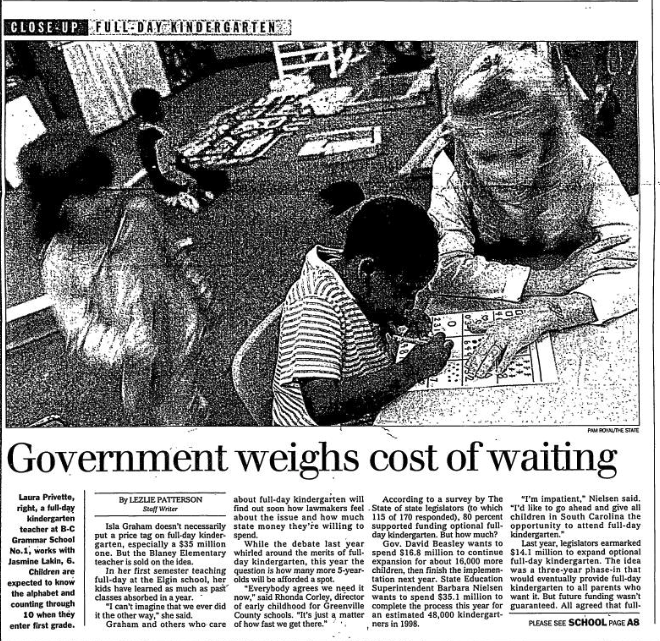
PHOTOS, color, bw1.Laura Privette, right, a full-day kindergarten teacher at B-C Grammer School No.1, works with Jasmine Lakin, 6. Children are expected to know the alphabet and counting through 10 when they enter first grade.
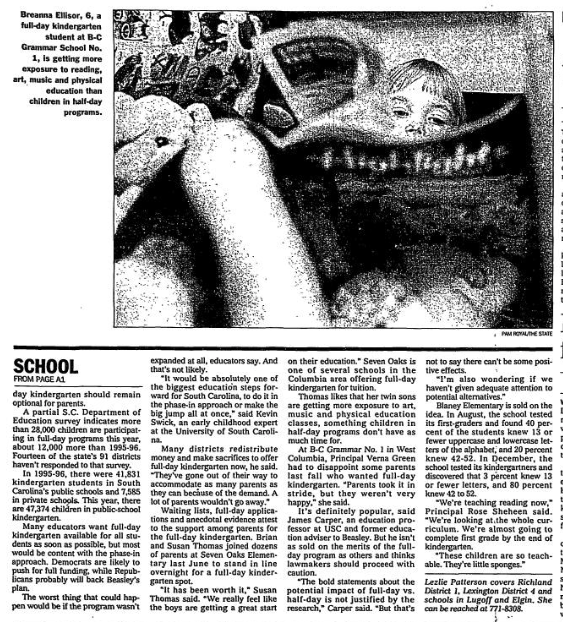
2.Breanna Ellisor, 6, a full-day kindergarten student at B-C Grammer School No.1, is getting more exposure to reading, art, music and physical education than children in half-day programs.
PAM ROYAL / THE STATE
Page 1
Page 8