Conder Elementary teacher Brooke Ross went grocery shopping for class the other day.
She bought a bottle of hot sauce, a can of Vienna sausages and a box of corn muffin mix.
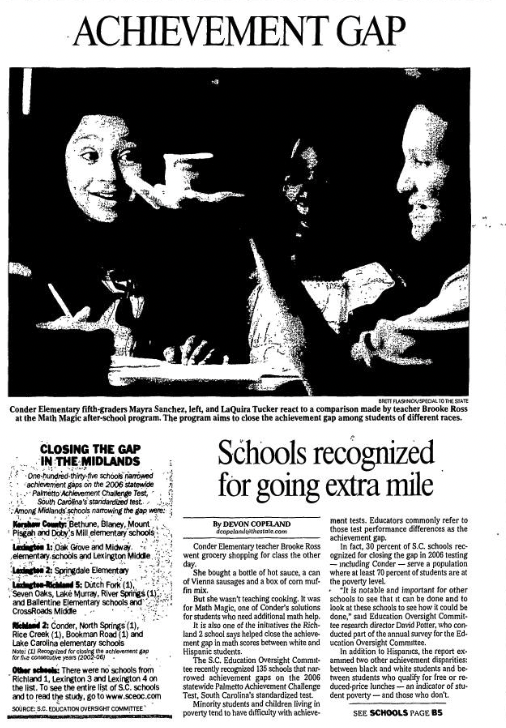
But she wasn’t teaching cooking. It was for Math Magic, one of Conder’s solutions for students who need additional math help.
It is also one of the initiatives the Richland 2 school says helped close the achievement gap in math scores between white and Hispanic students.
The S.C. Education Oversight Committee recently recognized 135 schools that narrowed achievement gaps on the 2006 statewide Palmetto Achievement Challenge Test, South Carolina’s standardized test.
Minority students and children living in poverty tend to have difficulty with achievement tests. Educators commonly refer to those test performance differences as the achievement gap.
In fact, 30 percent of S.C. schools recognized for closing the gap in 2006 testing — including Conder — serve a population where at least 70 percent of students are at the poverty level.
“It is notable and important for other schools to see that it can be done and to look at these schools to see how it could be done,” said Education Oversight Committee research director David Potter, who conducted part of the annual survey for the Education Oversight Committee.
In addition to Hispanics, the report examined two other achievement disparities: between black and white students and between students who qualify for free or reduced- price lunches — an indicator of student poverty — and those who don’t. Principal Shirley Watson said she would especially like to close those gaps at Conder, where more than 80 percent of the elementary school’s population is at poverty level.
That’s why programs like Math Magic are important, school officials say.
Two afternoons a week, students attend Math Magic, which runs from October through the week before PACT testing — this year in early May.
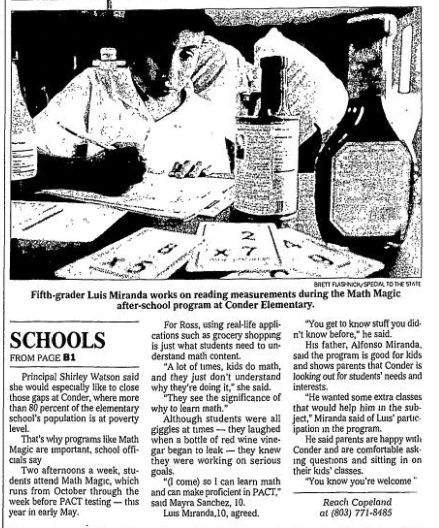
For Ross, using real-life applications such as grocery shopping is just what students need to understand math content.
“A lot of times, kids do math, and they just don’t understand why they’re doing it,” she said.
“They see the significance of why to learn math.”
Although students were all giggles at times — they laughed when a bottle of red wine vinegar began to leak — they knew they were working on serious goals.
“(I come) so I can learn math and can make proficient in PACT,” said Mayra Sanchez, 10. Luis Miranda, 10, agreed.
“You get to know stuff you didn’t know before,” he said.
His father, Alfonso Miranda, said the program is good for kids and shows parents that Conder is looking out for students’ needs and interests.
“He wanted some extra classes that would help him in the subject,” Miranda said of Luis’ participation in the program.
He said parents are happy with Conder and are comfortable asking questions and sitting in on their kids’ classes. “You know you’re welcome.”
Reach Copeland at (803) 771-8485.
* * *
CLOSING THE GAP IN THE MIDLANDS
135 schools narrowed achievement gaps on the 2006 statewide Palmetto Achievement Challenge Test, South Carolina’s standardized test. Among Midlands schools narrowing the gap were:
* Kershaw County: Bethune, Blaney, Mount Pisgah and Doby’s Mill elementary schools
* Lexington 1: Oak Grove and Midway elementary schools and Lexington Middle
* Lexington 2: Springdale Elementary
* Lexington-Richland 5: Dutch Fork (1), Seven Oaks, Lake Murray, River Springs (1) and Ballentine Elementary schools and CrossRoads Middle
* Richland 2: Conder, North Springs (1), Rice Creek (1), Bookman Road (1) and Lake Carolina elementary schools
Note: (1) Recognized for closing the achievement gap for five consecutive years (2002-06)
* Other schools: There were no schools from Richland 1, Lexington 3 and Lexington 4 on the list. To see the entire list of S.C. schools and to read the study, go to www.sceoc.com
———————
SOURCE: S.C. EDUCATION OVERSIGHT COMMITTEECaption: Photo(1) by BRETT FLASHNICK/SPECIAL TO THE STATE – Conder Elementary fifth-graders Mayra Sanchez, left, and LaQuira Tucker react to a comparison made by teacher Brooke Ross at the Math Magic after-school program. The program aims to close the achievement gap among students of different races.
Page 14
Page 15